Monday, October 18, 2010

(DA) Oct. 15, 2010: Neils Bohr

Bohr (1920s) 

  • Rutherford's model was inherently unstable
    - Protons and electrons should attract eachother
  • Matter emits light when it is heated (black body radiation)
  • Light travels as photons

    PHOTONS
  • The energy photons carry depends on their wavelengths
Bohr based his model on the energy (light emitted by different atoms. Each atom has a spectra of light. To explain this emission spectra, Bohr suggested that electrons occupy shells or orbitals
 
If given enough energy, an atom can move down or up levels of the orbitals.

BOHRS THEORY:
  • Electrons exist in ortibals
  • When they absorb energy they move to a higher orbital
  • As they fall from a higher orbital to a lower one they release energy as a photon of light.

Thursday, October 14, 2010

(TG) October 13, 2010: Atomic Theory

THE ATOMIC THEORY
ARISTOTLE:
  • One of the first theories ever created was called the "Four Elements Theory"
  • Consisted of: Water, Earth, Wind, and Fire
  • Lasted about 2000 years, but is not currently a valid theory because it cannot be proven 
DEMOCRITUS: 
  • In 300 BC Democritus said atoms were indivisible atoms
  • It was the first mention of atoms: atomos
  • Was only a conceptual model 
  • No mention of a nucleus
  • Does not explain Nuclear Reactions
LAVOISIER (LATE 1700'S)
  • Created the law of the conservation of mass: "in a chemical reaction no matter is destroyed or created"
  • Also had a law of definite proportions: (e.g. in a H20 molecule there is always 11% H and 89% O)
PROUST
  • In large proportions atoms have the same ratios as they do in molecules or compounds
  • Proved Lavoisiers Laws correct 
DALTON
  • Believed atoms are solid, indestructible spheres (e.g. billiard balls)
  • This theory provides an explanation for different elements
  • Based on the law of conservation of mass (if atoms are not destroyed, mass doesn't change)
  • Having a molecule explains the law of of Constant Composition
  • 2H2     + O2             =      2H2O 
J.J. THOMPSON
  • Raisin Bun model
  • solid, positive spheres, with negative particles embedded in them
  • first atomic theory to have positives and negatives
  • demonstrated the existence of electrons (cathode tube)  
 RUTHERFORD's assistant (1905) (
  • showed that atoms have a positive, dense, center, with electrons outside of it
  • resulted in planetary model
  • explains why electrons spin around nucleus
  • suggests that electrons are made up of mostly open spaces

RAISIN BUN MODEL


RUTHERFORDS MODEL (ELECTRON SPACING)

COMPARING THE MODELS
 

Tuesday, October 5, 2010

(DA) Oct. 4: Sodium Chloride Lab

Today we started off the class with a simple homework check.
Soon after we were given instructions on how to do our lab by Mr. Doktor (the best teacher in the world, as well as the smartest), and how to use each of the materials.


We split into groups of 3 and 4, and set off to gather our materials and safety clothing and equipment.
As we were in our groups we put our weight paper on the electronic scale and waited for Mr. Doktor to
put the Sodium Chloride (salt) onto the scale.


The Procedure we needed to follow:
1. Gather all the materials and put them on the lab bench

2. Measure 30 mL of distilled water using the graduated cylinder. Transfer this water into a 50 mL beaker
3. Weight 50g of Sodium Chloride.
4. Add Sodium Chloride to the water until it stops dissolving (the solution is saturated) and the first salt crystals begin appearing on the bottom of the beaker.
5. Measure the mass of salt remaining. Record the difference in salt as the amount added to 30 mL of water

6. Repeat steps 2-5 for 50 mL of water, 80 mL of water and 100mL of water.
7. Record all your data in the table below.
8. Create a graph of Mass of \salt vs. Volume of Water (Be sure you include a title, axis, data points, scale and a straight line of best fit). 


Electronic Scale:

Graduated Cylinder:

Beaker:

Friday, October 1, 2010

(NR) Sept 30: Density and Graphing

Density

- The density of an object is its mass divided by its volume. It is usually expressed in kg/L, kg/m^3, or g/cm^3.

example:

1) Determine the density of the hot tub that has the mass of 115kg and a volume of 70L.

d = 115 kg 
        70L

  = ____kg/L


(answer: 1.6 kg/L)

Graphing

  • All graphs MUST contain 5 important things:
    1) Labelled axis
    2) Appropriate scale
    3) Title
    4) Data points
    5) Line of best fit line
  • Three things can be done when working with graphs:
    1) Read the graph.
    2) Find the slope (RISE/RUN)
    3) Find the area under the graph.


m1) rise = 4                           m2) rise = 2                          m3) rise = 4                              m4) rise = 2      
       run     1                                  run    1                                 run     2                                     run     1
             
      = 4 miles/hour                 = 2 miles/hour                       = 2 miles/hour                           = 2 miles/hour

m5) rise  = 0
       run     1
    
     = 0 mile/hour

AREA:

a = 1/2bh = 1/2(1)(4)                                   d= 1/2bh = 1/2(1)(2)
               = 2                                                               = 1
                                                                     = lw       = (10)(1)
b= 1/2bh = 1/2(1)(2)                                                  = 10
              = 1                                                 = 11
  = lw     = (4)(1)
             = 4                                                 e= lw     = (12)(1)
 =  5                                                                         = 12

c= 1/2bh = 1/2(2)(4)                                 
              = 4                                               TOTAL AREA: a + b + c + d + e
  = lw     = (2)(6)                                                                 = 2 + 5 + 16 + 11 + 12
             = 12                                                                      = 46 miles x hour
= 16

Tuesday, September 28, 2010

(TG) Sept 28: Dimensional Analysis

Want to know what 50km/hour is in miles? Its the speed limit, so it would be pretty useful to know if you were ever in a sticky situation...

  • This type of conversion is called Dimensional Analysis
  • It is very similar to the process of converting currencies
4 Steps to Know:
  1.    Find a unit equality
  2.    Find the conversion factors
  3.    Apply Conversion Factors 
  4.    Cancel Units

EXAMPLES:

50 km/hour to miles/hour

50km/h x 1mile/1.6km

UNITS CANCEL: km's is crossed out in the equation

You now multiply the two fractions and get:

50/1.6 per hour

50/1.6 = 31.25

Final Answer: 50km/hour is = to 31.25mi/hour


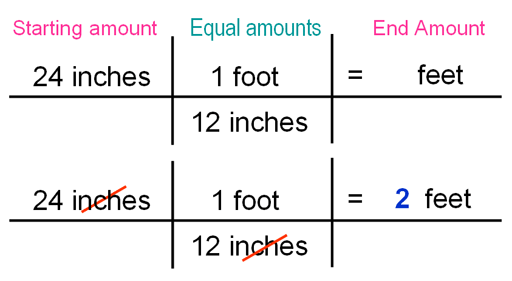
A Helpful Picture to Illustrate the Process:

Friday, September 24, 2010

(NR) Sept 23: Scientific Notation & Significant Digits

TO REMEMBER!
* Accuracy and precision is VERY important in science.
* Calculators are NOT smart enough to decide what is precise and what isn't.
* Scientists have established rules for rounding off extra digits; you MUST follow them!


SIGNIFICANT DIGITS

  • Non-zero digits are always significant.
  • If the zero is a place keeper it is not significant.
    example: 0.0098 (2 s.d.)
                  0.00043 (2 s.d)
  • Any numbers to the left of a decimal point are significant.
    example: 2.00, 27.06, 38.9000
  • Zeros after another number are significant.
examples:

HOW MANY SIGNIFICANT DIGITS ARE IN...

14.78? ............_____s.d.
2.04? .............._____s.d.
9.00? .............._____s.d.
0.0038?..........._____s.d.

(answers: 4 s.d., 3 s.d., 3 s.d., 2 s.d.)

  • when you multiply/divide ROUND to the number wit hthe fewest S.D.'s 
    example:

    • 1.38797 x 38.234 = 53.067644 => 53.068

SCIENTIFIC NOTATION

  • used if we need to write the number 2000 with only 2 s.d.'s
    > 2.0 x 10 ^ 3
  • used if we want to write the number thirty three billion four hundred million without taking up an entire line.
  • Shows really big or really small numbers easily
  • makes use of power of 10 
examples:
10^5 = 100000
10^-5 = 0.00001

-convert each question into scientific notation.

13400000 => ____ x 10^__
0.00000542 => ____ x 10^__
23900000 => ____ x 10^__

(answers: 1.34 x 10^7, 5.42 x 10^-6, 2.39 x 10^7)

REMEMBER:
DO NOT USE "^" ON YOUR CALCULATOR!!!  

Wednesday, September 22, 2010

(DA) Sept 21: SI System & Percent Error

Prefixes Used with SI Units
  • We can put a prefix in front of the unit and change the power of it
         - tera (T) 10^12
         - giga (G) 10^9
         - mega (M) 10^6
         - kilo (K) 
10^3
         - hecto (h) 10^2
         - deca (da) 10^1

SI Prefixes


  • The SI System uses many prefixes to represent very large or very small numbers
    - deci (d) 10^-1
    - centi (c) 10^-2
    - milli (m) 10^-3
    - micro (
    ยต) 10^-6
    - nano (n) 10^-9
    - pico (p) 10^-12
    - fempto (fm) 10^-15


***Don't use scientific notation and prefixes together! IT BECOMES VERY CONFUSING.
Experimental Accuracy


  • In general, the maximum accuracy of any measurement is half of the smallest division of the measuring device
  • A ruler with measurements of millimeters has a meximum accuracy of +/- 0.5mm
  • The odometer in a car has a maximum accuracy of +/- 50m.
EXAMPLE:
  • A graduated cylinder has units of 1.0 mL. The accuracy of the cylinder is +/-0.5mL
  • Liquid in a graduated cylinder will typically form a curved top called a meniscus
  • The volume is taken at the bottom of the cylinder
The curved top is called a Meniscus

Expressing Error
  • Error is a fundemental part of science
  • There are usually 3 reasons of error
    1) Physical errors in the measuring device
    2) 'Sloppy' measuring
    3) Changing ambient conditions
Calculating Error
  • Two different possibilities

    1) Absolute Error
             - Measured value minus accepted value
             - Absolute Error = Measured - Accepted

    2) Percentage Error
             - Most common
             - Percent Error = Absolute Error / Accepted Value
        
          |  Measured - Accepted |
    % = |           Accepted           | x100